

What Is DLC Certification for LED Lighting?
DLC certification (issued by the DesignLights Consortium) is independent, third-party verification that a commercial LED lighting product meets strict performance standards for energy efficiency, light output, color quality, and longevity. It is the industry's go-to "quality stamp" for commercial lighting in North America, and it is what unlocks most utility rebates.VOTATEC
Who is the DesignLights Consortium?
The DLC is a non-profit organization — not a government agency — founded in 1998 as a regional initiative of the Northeast Energy Efficiency Partnerships (NEEP). Funded by utilities and industry groups, it has grown into North America's most authoritative independent voice on commercial LED lighting quality.Faraday Lighting
A key distinction: DLC is a performance and quality certification, not an electrical safety certification. Safety marks such as UL, CSA, or ETL certify that a product won't catch fire or shock someone; DLC certifies that it actually performs — efficiently and reliably.
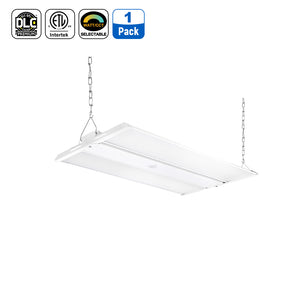
What "DLC-listed" means
When a product is "DLC certified," it has been tested by an approved lab and added to the DLC's Qualified Products List (QPL) — a public, searchable database of verified products. Being on the QPL signals to buyers and utilities that the product meets documented minimums for efficacy, color quality, and rated life.Beyond LED Technology.
How a product gets certified:

What DLC actually tests
Under its Solid-State Lighting (SSL) technical requirements, DLC verifies several measurable properties: luminous efficacy (lumens per watt), light output, color rendering index (CRI), color quality, and rated lifetime (from LM-80/TM-21 data). Products that fall short of these thresholds don't get listed.
Two qualification tiers exist:
- DLC Standard — the baseline. Under V5.1, typical efficacy requirements run roughly ≥100 lm/W (higher for some categories), with CRI ≥ 70 (≥80 for display).Fanxstar
- DLC Premium — a higher-performance tier with stricter efficacy (often ≥120–170 lm/W depending on category) and tighter color-quality testing, typically rewarded with larger rebates.Fanxstar
DLC also maintains a separate Networked Lighting Controls (NLC) QPL — the only list of its kind — for connected lighting-control systems.LED professional
DLC vs. ENERGY STAR
They're complementary, not the same thing. ENERGY STAR covers residential and some commercial products and is an EPA-administered label. DLC focuses specifically on commercial, institutional, and industrial lighting. Many projects need both — ENERGY STAR for the consumer angle and DLC for utility-rebate eligibility.
Why it matters
- Rebate access: roughly 75% of utility efficiency/rebate programs reference the DLC QPL — a DLC-listed product is typically required to get the rebate.Fanxstar
- Quality assurance: the QPL filters out poorly performing fixtures before they reach spec.
- Simplified procurement: buyers can search the public QPL and confidently specify listed models.
A note on current standards
The DLC is transitioning to SSL V6.0 (released November 2025; applications under V6.0 accepted from January 5, 2026). V6.0 raises minimum efficacy thresholds by an average of about 14% (up to ~19% in some products) — meaning some products that qualified under V5.1 will fall below the new bar and lose rebate eligibility.Guangdong Mason Technologies Co., Ltd.compare2best.com
The bottom line
DLC certification is the mark that a commercial LED product actually delivers on efficiency, color, and lifespan — and it's the key that unlocks utility rebates. When choosing fixtures for a commercial project, checking the DLC Qualified Products List is one of the fastest ways to verify a product is genuinely high-performing and rebate-eligible.


