

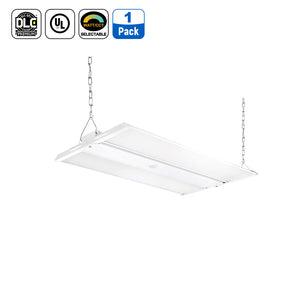
High bay lights are specialized, high-intensity lighting fixtures designed to illuminate large indoor areas with high ceilings—typically 20 feet (approx. 6 meters) to 45 feet or higher.
Because high ceilings leave a large space between the light source and the floor, high bay lights are built with powerful outputs and focused beam angles to throw bright, uniform light down over a wide distance without excessive glare.
Key Applications & Common Uses
-
Warehouses & Logistics Hubs: Illumination of high-density storage racks, aisle ways, and loading docks to ensure workers can read labels and operate forklifts safely.
-
Manufacturing & Industrial Plants: Providing bright, clear light for assembly lines, machinery operations, quality control, and heavy manufacturing.
-
Commercial Retail & Big-Box Stores: Used in large retail stores (like home improvement stores or wholesale clubs) to brightly light up product displays across expansive sales floors.
-
Sports Facilities & Gymnasiums: Ideal for indoor basketball courts, sports arenas, indoor turf fields, and fitness centers requiring even, glare-free coverage.
-
Aircraft Hangars & Large Garages: Lighting massive open spaces needed for vehicle maintenance, aircraft storage, or heavy equipment repairs.
-
Community Centers & Event Spaces: Applied in large multipurpose halls, exhibition centers, and convention spaces.
Why Use High Bay Lights?
-
Powerful Illumination: They produce high lumen output (typically 10,000 to 40,000+ lumens) to properly light vast square footage.
-
Focused Lighting: Equipped with specialized reflectors or lenses (often $60^\circ$, $90^\circ$, or $120^\circ$ beam spread) to direct light down efficiently rather than wasting it on high walls or ceilings.
-
Energy Efficiency (LED High Bays): Modern LED high bays consume significantly less energy and produce far less heat compared to older Metal Halide (MH) or High-Pressure Sodium (HPS) fixtures.
-
Durability: Built with heavy-duty aluminum housings and industrial-grade components to withstand high temperatures, dust, and continuous commercial use.
Here is a complete guide to help you select, calculate, and layout high bay lights for your project.
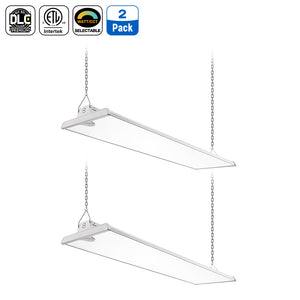
1. Choosing the Right Style: UFO vs. Linear
The best style depends directly on the layout of your space:
| Feature | UFO (Round) High Bays | Linear (Rectangular) High Bays |
| Best For | Open floor plans, gymnasiums, round spaces, high-ceiling manufacturing. | Storage aisles, pallet racks, corridors, workshops, assembly lines. |
| Beam Pattern | Circular / Cone ($360^\circ$ circular spread). | Rectangular / Elongated (focused along the row). |
| Mounting | Single-point (hook or pendant)—quickest to install. | Dual-point (V-hooks/chains) or surface mount. |
| Durability | High IP ratings (often IP65 wet/dust resistant). | Ideal for replacing old fluorescent T5/T8 tube fixtures. |
2. Choosing Output by Ceiling Height
Select your fixture wattage and brightness based on mounting height:
-
12 ft – 15 ft: ~10,000 to 15,000 Lumens (80W – 100W LED)
-
15 ft – 20 ft: ~16,000 to 22,000 Lumens (120W – 150W LED)
-
20 ft – 30 ft: ~25,000 to 32,000 Lumens (200W LED)
-
30 ft +: 40,000+ Lumens (240W to 300W+ LED with narrow beam angles, e.g., $60^\circ$ or $90^\circ$)
3. How to Calculate How Many Lights You Need
Step A: Target Foot-Candles (FC)
Foot-candles measure light brightness on the floor:
-
Inactive storage / dead space: 10–20 FC
-
Standard warehouse / active aisles: 30–40 FC
-
Detailed work / inspection / workshops / retail: 50–75+ FC
Step B: The Core Formula
Quick Example:
A 40 ft × 50 ft (2,000 sq ft) workshop at a 20 ft ceiling height needing 40 FC:
$\text{Total Lumens} = 2,000 \times 40 = 80,000\text{ lumens}$
Using 20,000-lumen fixtures ($150\text{W}$ LED):
$$\text{Fixtures} = \frac{80,000}{20,000} = 4\text{ fixtures}$$
Call +1 718-688-9188 to speak with a US-based lighting professional expert or browse High Bay lights at www.jcelighting.com.


