

Neither is inherently "better" — the right choice depends on your ceiling height, budget, and how much control you need over glare and light distribution.
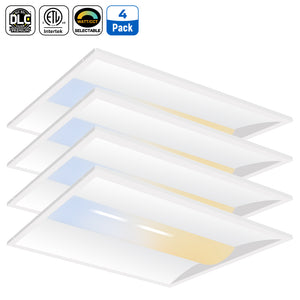
The short version: LED panels win on aesthetics and cost, while LED troffers win on optical control and visual comfort.
Key Differences at a Glance
Here's how they compare on the specs that matter most:
-
Profile & Clearance: Troffers are deeper, typically 3 to 5 inches, requiring more plenum space. Panels are ultra-thin, often less than 1 inch, making them ideal for tight ceilings or shallow plenums.
-
Light Source: Troffers use a center "basket" that bounces light off reflectors for an indirect/direct glow. Panels are either edge-lit (LEDs around the frame) or back-lit (LEDs across the back).
-
Light Quality & Glare: Troffers generally offer better visual comfort and more controlled distribution. Panels provide a uniform, "skylight" look, but cheaper models with smooth opal diffusers can cause harsh glare on computer screens.
-
Efficacy: Back-lit panels are highly efficient (direct path). Troffers offer high efficacy, though some deeper volumetric designs may have slightly lower lm/W than the best back-lit panels. Edge-lit panels are generally the least efficient.
-
Cost: Panels are typically less expensive than troffers, which have more complex housings and optical components.
-
Maintenance: Most panels are integrated units; if the LED or driver fails, you often replace the whole fixture. Troffers can sometimes use replaceable LED strips or drivers.
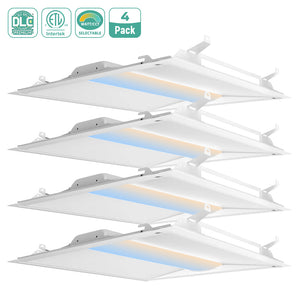
Which One Should You Choose?
Choose LED Panels
-
You want a modern look on a budget: Panels offer a clean, seamless ceiling aesthetic for less money.
-
Your ceiling is shallow: If your plenum space is tight (e.g., under ducts or in renovations), the ultra-thin profile is essential.
-
You need flexibility: Panels can be recessed, surface-mounted, or suspended, while troffers are primarily for recessed grid ceilings.
Choose LED Troffers
-
You have a screen-heavy environment: For offices with lots of monitors, troffers offer better optical control to reduce veiling reflections and eye strain. Look for volumetric designs with microprismatic lenses.
-
You need high output or specific optics: Troffers are available with various lenses and higher lumen packages for specific task lighting.
-
You are retrofitting existing fixtures: Troffers are drop-in replacements for old fluorescent fixtures, and you can sometimes keep the existing housing to save on labor.
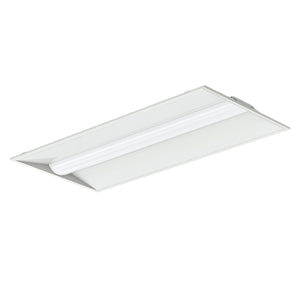
A Note on Quality
If you go with panels, avoid edge-lit models with cheap plastic light guide plates (LGPs), as they can yellow over time and shift color. Back-lit panels are a safer bet for longevity and efficiency.
Call +1 718-688-9188 to speak with a US-based lighting professional expert or browse Commercial LED Troffers and LED Panels. at www.jcelighting.com


