

Choosing the right LED canopy lights for a gas station requires balancing visibility, customer safety, branding, energy efficiency, and long-term durability. Gas station canopies operate continuously—often 24/7—and act as the primary visual draw for nighttime drivers.
Key Selection Criteria
1. Light Output (Lumens & Foot-Candles)
-
Target Illumination (Foot-Candles): Per IES standards, the area directly under the canopy and around fuel pumps should maintain 20 to 30 foot-candles (fc) at the ground surface (or 30 to 50 fc at the pump/dispenser level).
-
Lumen Package: For standard canopy mounting heights (14–17 ft), fixtures delivering 10,000 to 15,000 lumens (approx. 75W–100W LED) work best. For higher canopies or wider spacing, aim for 18,000 to 22,000 lumens (approx. 120W–150W LED).
-
2. Color Temperature (CCT) & Color Accuracy (CRI)
-
5000K (Daylight White): The industry standard for gas stations. It provides a crisp, bright visual environment that increases driver alertness and promotes safety.
-
4000K (Neutral White): Ideal if local dark-sky ordinances restrict 5000K, or to create a warmer, less harsh look.
-
CRI $\ge$ 80: High Color Rendering Index ensures vehicles, license plates, and signage show accurate colors on security cameras and to the naked eye.
3. Fixture Mounting Type & Form Factor
-
Recessed Pan Canopy Lights: Best for new builds or clean retrofits with drop ceiling panels. They offer a flush, modern look with excellent glare control.
-
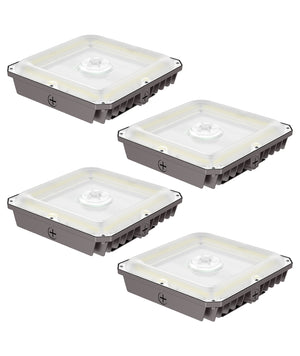
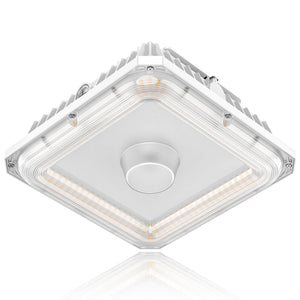
Surface Mount / Low-Profile Square Fixtures: Common for retrofitting existing solid canopies. They mount directly to the canopy deck or junction box.
-
Optics & Lens: Choose frosted or prismatic lenses with Type V (symmetrical) distribution or full-cutoff optics. This minimizes glare for drivers pulling into the station while providing uniform light without dark spots.
4. Durability & Weatherproofing Ratings
-
IP Rating: Look for IP65 or IP66 ratings. Fixtures must withstand blowing rain, dust, temperature swings, and engine exhaust gases.
-
Impact Rating (IK Rating): High-impact polycarbonate or tempered glass lenses (IK08 to IK10) protect against high-vehicle clearance bumps, antennas, or debris.
-
Thermal Management: Aluminum die-cast housings act as heat sinks to extend driver and LED chip life in extreme weather.
5. Smart Controls & Certifications
-
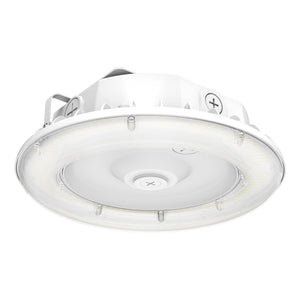
0–10V Dimming & Photocells: Pairing dusk-to-dawn photocells with 0–10V dimming drivers allows fixtures to run at full power during peak hours and dim to 50% during overnight low-traffic hours, significantly reducing operating costs.
-
Certifications: Ensure fixtures are UL or ETL listed for wet locations. Look for DLC Premium (DesignLights Consortium) certification to maximize eligibility for local utility rebates.
Layout & Quantity Quick-Reference
| Canopy Size | Pumps / Dispensers | Est. Fixture Count | Recommended Fixture Output |
| Small | 2 Pumps (1 island) | 4 – 6 fixtures | 60W – 75W (8,000 – 10,000 lm) |
| Medium | 4 Pumps (2 islands) | 8 – 12 fixtures | 75W – 100W (10,000 – 15,000 lm) |
| Large | 6+ Pumps (3+ islands) | 12 – 20+ fixtures | 100W – 150W (15,000 – 22,000 lm) |
Placement Tip: Position fixtures between and slightly offset from the pumps rather than directly over the dispenser tops to prevent casting direct glare into customers' eyes when looking up. Space fixtures 8 to 14 feet apart for seamless, uniform coverage.
LED Canopy Lights FAQs
When Are LED Canopy Lights The Right Fit?
LED canopy lights are a good fit for covered areas that need broad, even illumination from lower ceiling heights, including parking garages, gas station canopies, workshops, drive-thrus, loading canopies, and covered walkways. They are not always the best choice for high ceilings, open parking lots, hazardous locations, or applications requiring precise directional aiming.
How Should I Choose Between Recessed, Surface, And Pendant Mount Canopy Lights?
Choose the mounting style based on the ceiling structure and existing mounting conditions. Recessed fixtures suit flush-mounted retrofits, surface fixtures mount directly to the ceiling, and pendant fixtures are used where the light must be suspended lower from the ceiling structure.
What Should Be Considered When Planning Fixture Quantity And Spacing?
Fixture quantity and spacing should be based on mounting height, lumen output, beam spread, fixture spacing, and photometric performance rather than wattage alone. Foot-candle guidance can help with light-level planning, but it does not determine fixture count or spacing; larger or code-sensitive projects should have a lighting plan reviewed before ordering.
How Do I Choose Canopy Lights For Exposed Or Wet Areas?
Confirm the selected fixture's IP rating and wet-location suitability when the installation is outdoors, partially exposed, or subject to direct weather exposure. Damp-location-only fixtures should not be used where direct weather exposure is present.
When Should Motion Sensors, Dimming, Or Photocells Be Considered?
Motion sensors and dimming can reduce energy use in low-traffic areas, depending on fixture compatibility, occupancy patterns, sensor settings, and local requirements. Photocells may be useful for outdoor or dusk-to-dawn applications, but existing photocell, timer, or building automation controls should be confirmed to avoid control conflicts.
What Should Be Verified Before Replacing Existing Canopy Fixtures?
Before ordering retrofit canopy lights, confirm mounting height, voltage, mounting method, recessed box or ceiling opening dimensions, lumen output, beam spread, wet-location rating, controls compatibility, and emergency backup requirements. For recessed retrofits, measure existing recessed boxes, junction boxes, ceiling openings, mounting surfaces, and conduit locations.
Can Standard LED Canopy Lights Be Used In Fuel Canopies Or Hazardous Locations?
Standard canopy lights should not be assumed suitable where hazardous-location ratings are required. Some fueling areas may have classified-location requirements depending on fixture location, fuel dispensing layout, and local code interpretation, so confirm whether a standard canopy fixture is allowed before ordering.
Call +1 718-688-9188 to speak with a US-based lighting professional expert or browse Commercial LED Canopy Light at www.jcelighting.com.


