

1. Modular LED Stadium Lights
Consist of multiple independent light modules. Each module features separate heat dissipation and lenses. Single module failure will not shut down the whole light. Various beam angles (15°, 25°, 40°, 60°) can be mixed and matched freely. They deliver excellent heat dissipation for high-power models.
Advantages: Easy maintenance, flexible light distribution, convenient separate packaging and transportation.
Disadvantages: Higher cost and relatively large size.
Application: Professional football fields, athletics tracks, large comprehensive stadiums and broadcast-ready venues.
2. Integrated Square LED Flood Lights
Adopt an integrated die-cast aluminum housing with an all-in-one light source cavity. Power range is mainly 200W–600W.
Advantages: Simple structure, cost-effective, compact and lightweight for installation.
Disadvantages: The whole light needs replacement if the light source fails; limited heat dissipation capacity, rarely available above 1000W; fixed beam angle without flexible combination.
Application: Basketball courts, tennis courts, small sports grounds, campus training venues.
Long strip shape with light sources arranged horizontally. They produce wide, even horizontal illumination and effectively reduce glare with lower wind load than square fixtures.
Advantages: Uniform light spread, good glare control.
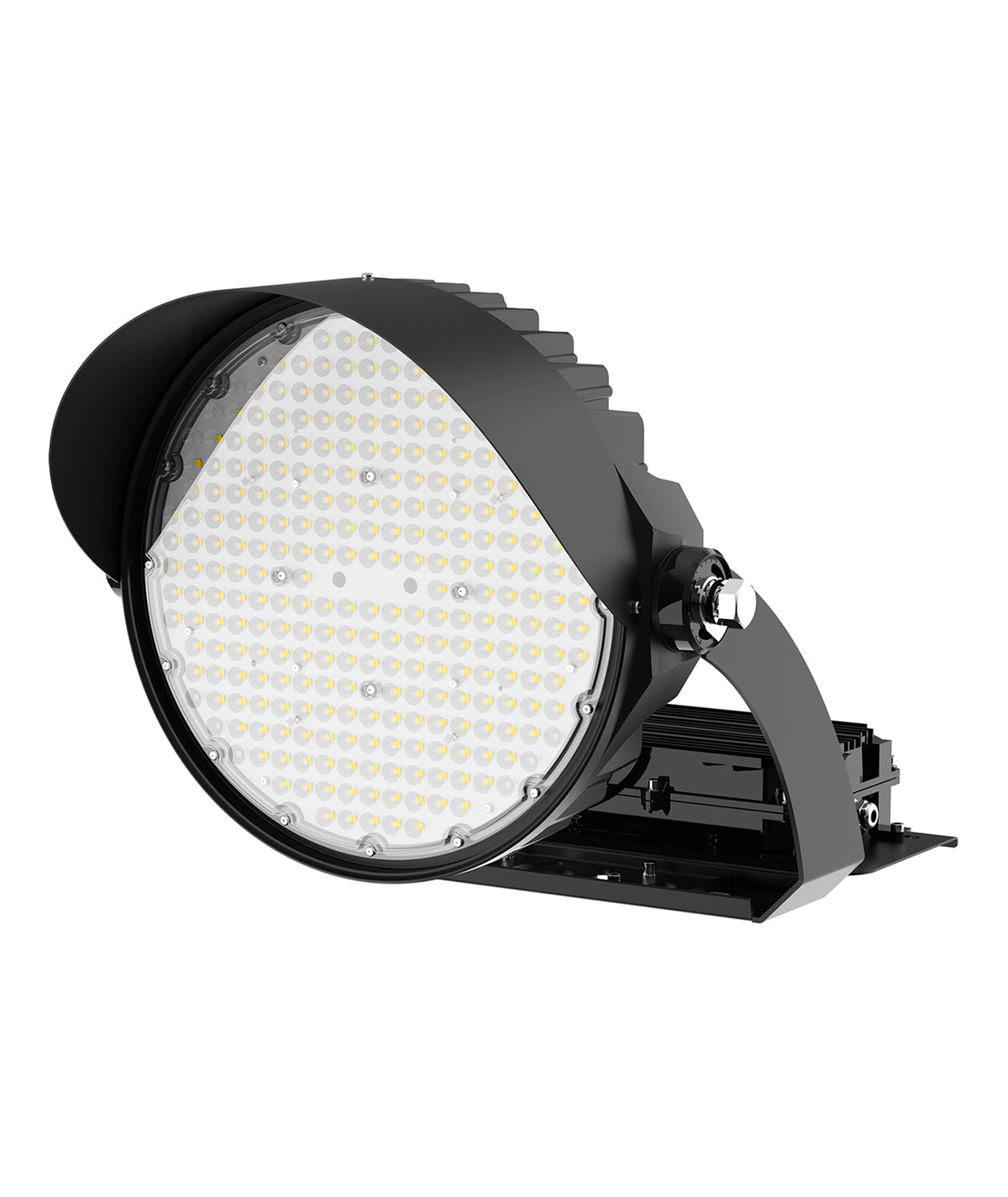
4. UFO High Mast LED Lights
Circular UFO-shaped design with downward-oriented light distribution. Originally used for industrial warehouses and later adapted for medium-low height sports venues.
Advantages: Lightweight, low wind resistance and competitive price.
Disadvantages: Hard to achieve ultra-narrow beam angles; poor long-range projection; mediocre anti-glare performance.
Application: Indoor gymnasiums, small 5-a-side football pitches, community courts with pole height below 12m.
5. Long-range Narrow Beam Sports Lights
Equipped with 15° / 25° ultra-narrow lenses optimized for concentrated long-distance projection. Widely used for supplementary lighting on high masts of 25–35m large stadiums.
Advantages: Long lighting range, concentrated light and reduced light waste.
Disadvantages: Small coverage area. Must be combined with wide-angle lights to avoid uneven illumination.
Application: Supplementary lighting for large professional stadiums.
6. Indoor Arena LED Lights
Optimized for low UGR glare control. Many models support flicker-free output to meet requirements of indoor competitions and filming. CCT options are mainly 4000K–5000K. Lightweight structure for ceiling mounting.
Advantages: Low glare to avoid distracting athletes and audiences.
Disadvantages: Limited waterproof rating, not suitable for direct outdoor exposure.
Application: Indoor basketball halls, badminton courts, volleyball halls and multi-purpose indoor sports venues.


