

Advantages & Disadvantages of Different Stadium Light Installation Heights
Stadium light mounting height is normally grouped into low‑height (8‑18 m), medium‑height (18‑25 m), and high‑mast height (25‑50 m). Each height brings trade‑offs for illumination, pole cost, wind load, glare, maintenance and light spill.
1. Low‑height installation: 8 m‑18 m
(Mostly for square modular LED floodlights; community courts, basketball, tennis, small training fields)
Advantages
- Lower pole material and foundation cost; simpler civil construction.
- Lower fixture position → easier on‑site maintenance and lamp replacement, no large high‑altitude lifting equipment required.
- Shorter projection distance, so lower‑wattage lamps can achieve target brightness.
- Light beams hit the ground at steeper angles, relatively good ground uniformity within small‑to‑medium courts.
Disadvantages
- Requires more light poles / more fixtures. Multiple corner‑side poles are needed to cover the whole field.
- Higher glare risk for athletes and spectators. Light travels horizontally close to players’ eye level.
- More light spill outside field boundaries; hard to control stray light for large pitches.
- Not suitable for large venues like standard football or athletics tracks. Too many poles will block sightlines.
Best for: basketball, tennis, small multi‑sport community grounds.
2. Medium‑height installation: 18 m‑25 m
(Square fixtures dominant; mid‑size training soccer fields, semi‑professional courts)
Advantages
- Balanced performance between low‑height and high‑mast. Fewer poles than low‑mount solutions.
- Reduced direct glare compared with low‑height mounting; light projects downwards at better angles.
- Moderate pole cost; foundation engineering complexity stays manageable.
- Good compatibility with rectangular‑beam square LED stadium lights, high light‑utilization ratio for rectangular sports surfaces.
Disadvantages
- Wind load becomes noticeable, especially for square‑shape large‑area lamp housings. Pole and base need structural calculation.
- Maintenance needs aerial work platforms, higher service cost than low‑height.
- If beam angles are poorly selected, hot‑spots or dark corners easily occur across large fields.
- Cannot cover very large professional stadiums; coverage distance is limited.
Best for: training soccer pitches, regional competition‑level courts.
3. High‑mast installation: 25 m‑50 m
(Mainly uses round aerodynamic LED stadium lights; professional stadiums, athletics tracks, large football grounds)
Advantages
- Very few poles are needed. Less pole obstruction, clean sightlines for audiences and cameras.
- Light shines from high above, effective glare suppression; less direct light into athletes’ eyes.
- Long‑throw capability to cover huge continuous playing areas. Ideal for broadcast‑level stadium lighting.
- Good control of light spill when matched with proper narrow‑medium beam lenses.
Disadvantages
- Huge investment: tall poles, heavy‑duty foundations, and structural wind‑load engineering push up total project cost greatly.
- High‑altitude maintenance is difficult and costly. Special lifting equipment or lowering‑mast systems are often required.
- Higher power lamps are mandatory to compensate for long projection distance. Higher total system power consumption.
- Wind‑load is critical. Even aerodynamic round lamps impose big wind force on high masts; strict structural safety calculation is non‑negotiable.
- Small aiming errors at high height translate into large position deviations on the ground, requiring precise aiming work.
Best for: professional stadiums, athletics tracks, large competition‑grade football pitches.
Summary Comparison Table
| Mounting Height | Pros | Cons | Typical Lamp Style |
|---|---|---|---|
| 8‑18 m Low | Low cost, easy maintenance, low lamp power | Many poles, high glare, poor for big fields | Square LED floodlights |
| 18‑25 m Medium | Balanced glare & pole quantity, good for training venues | Wind‑load concern, need aerial maintenance | Square LED stadium lights |
| 25‑50 m High‑mast | Few poles, low glare, wide coverage, TV‑broadcast friendly | High total cost, hard maintenance, strict wind‑load requirement | Round aerodynamic LED stadium lights |
Key Practical Tips
- Height and beam angle must match: Higher mounting → select narrower beam angles.
- Always run DIALux simulation. Height decision cannot rely only on experience.
- Wind‑load calculation is mandatory for heights above 18 m, especially when using square‑housing fixtures.
- High‑mast projects should evaluate whether to adopt lowering‑mast devices for future maintenance convenience.
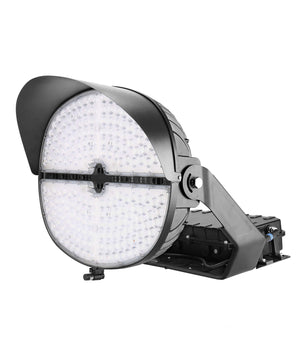
Typical Installation Heights for Round & Square LED Stadium Lights
Installation height is closely tied to fixture shape, power, beam angle, venue type, and lighting standard requirements. Below are industry‑typical practical ranges.
Round LED Stadium Lights
Designed mainly for high‑mast tall‑pole applications
- Common height range: 20 m – 50 m
- Most frequent working range for large stadiums / athletics tracks / football pitches: 25 m‑40 m
- Low‑limit rare use: Not recommended below 18 m. If mounted too low, the circular beam creates hot‑spots and uneven illumination.
Reason: Round fixtures feature low wind‑load, built for high‑altitude long‑throw projection; they deliver wide circular coverage over huge open areas.
Square LED Stadium Lights
Mostly modular floodlights for medium‑and‑low mounting positions
- Common height range: 10 m – 25 m
- Community courts, basketball / tennis / training fields: 10 m‑18 m
- Mid‑size soccer training grounds: 18 m‑25 m
- Upper limit: Square models can go above 25 m, but wind load rises sharply. If used above 25 m, pole mechanical strength must be reinforced.
Quick Reference Table
| Fixture Type | Typical Mounting Height | Main Venue |
|---|---|---|
| Round LED stadium light | 20‑50 m (optimum 25‑40 m) | Professional stadium, athletics track, large football field |
| Square LED stadium light | 10‑25 m (optimum 10‑18 m) | Community court, tennis, basketball, training pitch |
Key Practical Notes
- Height‑to‑beam‑angle matching
- High‑mount round lights → use narrow‑medium beam angles (15°‑30°) for long‑distance projection.
- Square lights at 10‑18 m → medium‑wide beam angles (30°‑60°) to spread light evenly across courts.
- Shape is not an absolute barrier:
- Square lights can be fitted on 25‑30 m masts, but must calculate wind‑load for pole structure.
- Round lights can also be used on medium‑height poles, yet they are less cost‑effective compared with square counterparts.
- Always follow lighting simulation results. Real‑world installation height shall be confirmed by DIALux lighting simulation rather than only following empirical height ranges.
Neither shape is universally superior. The better choice depends on your installation height, field layout, wind‑load conditions, coverage requirements and budget.
Round LED Stadium Lights
Pros
- Aerodynamic housing: Lower wind‑resistance (smaller effective projected area). Excellent for tall high‑mast poles, reduces wind‑stress on poles in windy regions.
- Smooth, circular light spread: Soft‑edged circular spot, good overall uniformity, fewer hard‑cut‑off shadows across large open‑air venues.
- Good heat dissipation: Perimeter‑style aluminum heat‑sink layout helps pull heat away from LED chips, supporting long service life.
- Flexible mounting: Supports flood‑mount and slip‑fit mounting, easy to aim precisely for multi‑sport venues.
Cons
- Less efficient for rectangular‑shaped sports fields; more light spill‑over outside field boundaries compared with square fixtures with rectangular‑pattern lenses.
- Usually higher unit price for equal wattage.
Best‑fit scenarios:
- Tall high‑pole installations (20 m‑50 m) for large‑scale stadiums, football fields, athletics tracks.
- Locations with strong wind.
- Venues prioritizing visual aesthetics.
Square LED Stadium Lights
Pros
- Matched rectangular light output: Square‑shaped beam pattern fits rectangular sports courts (soccer, basketball, tennis). Less light waste beyond field edges, better light‑utilization rate.
- Modular structure: Easy to add or remove LED modules; convenient maintenance. Widely used for high‑power fixtures (800 W‑1500 W).
- Cost advantage: Normally more cost‑effective per watt. Often fewer fixtures are required to cover the same field area.
- Great for corner‑pole installation, easy to cover diagonal zones of rectangular courts.
Cons
- Larger wind‑facing area. Higher wind‑load on tall poles, needs stronger pole‑structure in windy zones.
- Poor aerodynamic performance; heat‑dissipation depends heavily on fin‑quality of the module.
Best‑fit scenarios: ‑ Medium‑low mounting height (10‑25 m): basketball courts, tennis courts, community sports grounds, training fields. ‑ Rectangular‑shape courts, corner‑pole layout. ‑ Projects with tight‑budget constraints.
Quick Comparison Table
| Item | Round LED Stadium Light | Square LED Stadium Light |
|---|---|---|
| Wind resistance | Excellent (low wind‑load) | Fair‑good (higher wind‑load) |
| Light pattern | Circular spot, soft edge | Rectangular spot, fits rectangular courts |
| Mounting height | Tall poles (20‑50 m) | Medium‑low poles (10‑25 m) |
| Heat dissipation | Good perimeter‑sink | Depends on module fin design |
| Cost | Relatively high | More economical |
| Ideal layout | Side‑pole layout | Corner‑pole layout |
Practical Selection Advice
- For professional large stadiums with very high masts and windy environments → Round LED stadium lights.
- For community‑level courts, training grounds, medium‑height poles, rectangular‑shaped fields → Square LED stadium lights.
- Many real‑world projects use mixed‑configuration: round lamps for high‑pole long‑distance projection, square lamps for supplementing near‑field corner‑zone illumination.
Note: Fixture shape is only one factor. Beam‑angle selection, IP rating (IP66 recommended), CRI, surge‑protection and lighting simulation calculation are equally important for qualified stadium lighting.
Would you like me to give you a short one‑paragraph version for quotation‑sheet or report use?
What are the typical installation heights for round and square LED stadium lights?
Typical Installation Heights for Round & Square LED Stadium Lights
Installation height is closely tied to fixture shape, power, beam angle, venue type, and lighting standard requirements. Below are industry‑typical practical ranges.
Round LED Stadium Lights
Designed mainly for high‑mast tall‑pole applications
- Common height range: 20 m – 50 m
- Most frequent working range for large stadiums / athletics tracks / football pitches: 25 m‑40 m
- Low‑limit rare use: Not recommended below 18 m. If mounted too low, the circular beam creates hot‑spots and uneven illumination.
Reason: Round fixtures feature low wind‑load, built for high‑altitude long‑throw projection; they deliver wide circular coverage over huge open areas.
Square LED Stadium Lights
Mostly modular floodlights for medium‑and‑low mounting positions
- Common height range: 10 m – 25 m
- Community courts, basketball / tennis / training fields: 10 m‑18 m
- Mid‑size soccer training grounds: 18 m‑25 m
- Upper limit: Square models can go above 25 m, but wind load rises sharply. If used above 25 m, pole mechanical strength must be reinforced.
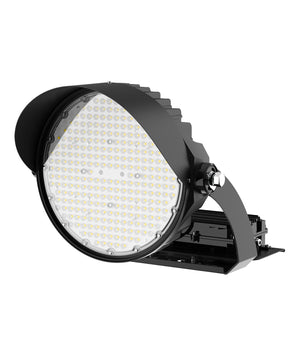
Quick Reference Table
| Fixture Type | Typical Mounting Height | Main Venue |
|---|---|---|
| Round LED stadium light | 20‑50 m (optimum 25‑40 m) | Professional stadium, athletics track, large football field |
| Square LED stadium light | 10‑25 m (optimum 10‑18 m) | Community court, tennis, basketball, training pitch |
Key Practical Notes
- Height‑to‑beam‑angle matching
- High‑mount round lights → use narrow‑medium beam angles (15°‑30°) for long‑distance projection.
- Square lights at 10‑18 m → medium‑wide beam angles (30°‑60°) to spread light evenly across courts.
- Shape is not an absolute barrier:
- Square lights can be fitted on 25‑30 m masts, but must calculate wind‑load for pole structure.
- Round lights can also be used on medium‑height poles, yet they are less cost‑effective compared with square counterparts.
- Always follow lighting simulation results. Real‑world installation height shall be confirmed by DIALux lighting simulation rather than only following empirical height ranges.


