

Lumen depreciation (also called lumen maintenance) means the gradual reduction of light output (luminous flux) of an LED light source over long‑time operation, while the LED is still functioning (it has not burned out completely).
Unlike traditional bulbs that suddenly burn out, LEDs seldom fail abruptly; they slowly get dimmer.
L70 (the most important standard parameter)
L70: The operating hours until the LED’s luminous output drops to 70% of its initial lumen value.
- Example: An LED fixture marked L70‑50000h → After 50,000 hours of running, its brightness falls to 70% of the original brightness. Many manufacturers use L70 as the rated service life of LED lights.
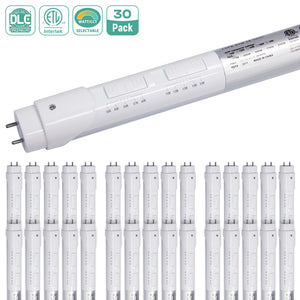
Other related indexes:
- L80: Time when brightness drops to 80% of initial output
- L90: Time when brightness drops to 90% of initial output
Main causes of LED lumen depreciation
- LED chip aging: Semiconductor material degrades under heat and electrical stress.
- Phosphor degradation: The yellow phosphor layer on blue LED chips ages, changes colour and reduces light output.
- Yellowing of encapsulant / resin: Silicone or epoxy packaging material turns yellow under high temperature and UV, blocking light.
- Poor heat dissipation (critical factor): Excess high temperature accelerates ageing dramatically. Bad heat sink will make lumen depreciation much faster, shortening L70 life.
- Driving power quality: Unstable current speeds up light decay.
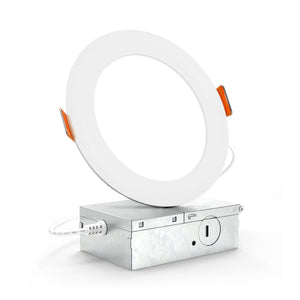
Practical meaning for application
- L70 does not mean the lamp will stop working at that hour; it just becomes noticeably dimmer.
- If an LED light runs in a hot enclosed fixture, its actual L70 lifespan will be shorter than the laboratory‑stated value.
- When selecting LED lighting, prefer products with a higher L70 hour rating and good thermal design to slow lumen depreciation.
Short summary
Lumen depreciation = LED light gradually dims with usage; L70 is the industry‑standard indicator to describe this light‑decay lifetime.
How to Calculate LED Lumen Depreciation?
Important note: Lumen depreciation cannot be simply calculated from a basic mathematical formula only. It relies on test data (LM‑80 report) from the LED component manufacturer, plus the environmental operating temperature.
1. Key definitions
- Φ₀ = Initial luminous flux (lumens at 0 hour, new lamp)
- Φₜ = Luminous flux after t hours of operation
- Lumen maintenance ratio (LM):
\(\boldsymbol{LM(t)=\frac{\Phi_t}{\Phi_0}\times100\%}\)
- Lumen depreciation percentage (light decay rate):
\(\boldsymbol{Lumen\ Depreciation (\%) = 100\%‑LM(t)}\)
Example: Initial lumen Φ₀ = 2000 lm; after 30000 hours actual output Φₜ =1400 lm
- Lumen maintenance = (1400 ÷ 2000) ×100% = 70%
- Lumen depreciation = 100% −70% = 30% This point is exactly the L70 condition.
This formula calculates actual measured depreciation after running. It cannot predict future depreciation by itself.
2. Predicting future lumen depreciation (forecast L value, TM‑21 method)
This is the standard industry prediction method (IES TM‑21), which works together with LM‑80 test report:
- LM‑80: Laboratory long‑term ageing test of LED emitters (minimum 6000 hours testing) to record lumen maintenance data.
- TM‑21: Mathematical extrapolation model to predict long‑term lumen maintenance from LM‑80 short‑term test data, to get L70, L80, L90 lifetime.
TM‑21 extrapolation is only for the LED package. The fixture’s real‑world depreciation is higher, because fixture operating temperature (heat sink, enclosed housing) accelerates ageing. You need to apply temperature derating.

Simple illustration of the exponential decay model used in TM‑21
\(LM(t)=100 \cdot e^{(-\alpha \cdot t)}\)
- LM(t): lumen maintenance (%)
- α: decay constant (derived by curve‑fitting from LM‑80 test data, you cannot pick α arbitrarily; it comes from component test report)
- t: operating hours
You cannot invent α. This is a very common mistake. You cannot calculate lifespan just on paper without LM‑80 data.
3. Practical workflow in engineering
- Obtain the LED emitter LM‑80 test report from LED supplier → get decay coefficient α at relevant LED junction temperature.
- Use IES TM‑21 to extrapolate and get component‑level L70 hours.
- Evaluate actual fixture junction temperature in application; if fixture runs hotter than LM‑80 test condition, apply thermal derating factor to adjust the predicted lumen maintenance curve for the complete luminaire.
- At target service hours, calculate: Depreciation % = 100 − LM(t)
4. Example for report
Given: From TM‑21 prediction, after 40000 h the LED module lumen maintenance =76% Lumen depreciation =100‑76 = 24 %
Summary
- Post‑fact calculation (known measured lumens): Depreciation % = \(100\% − (\Phi_t/\Phi_0)×100\%\)
- Prediction (forecast future depreciation): Must use LM‑80 test data + IES TM‑21 extrapolation model. The decay coefficient is taken from test results, not self‑assumed.
- Fixture thermal condition will increase real‑life lumen depreciation.
What is the lumen depreciation percentage of a typical LED light after 50,000 hours of operation?
Lumen Depreciation after 50 000 hours for typical LED lighting
Formula reminder: Lumen Depreciation (%) = 100% − Lumen‑Maintenance (%)U.S. Depar...
Industry baseline (L70‑50000 rating)
When an LED luminaire is specified as L70 @ 50 000 h (the most common commercial rating):
- Lumen maintenance = 70 %
- Lumen depreciation = 30 % at 50 000 hours (this is the rated end‑of‑useful‑life condition under IES TM‑21 extrapolation for the LED module in laboratory conditions)
This does NOT mean every LED will exactly hit 30 % depreciation. Actual value strongly depends on product quality, heat dissipation, operating temperature.
Typical real‑world ranges at 50 000 h (continuous operation)
-
High‑quality, well‑cooled commercial / industrial LED (good heat sink, proper driver)
- Lumen maintenance: 75‑85 %
- Lumen depreciation: 15 %‑25 %
-
Standard typical mid‑grade commercial LED (the common “L70‑50000” product)
- Lumen maintenance: ~70‑75 %
- Lumen depreciation: 25 %‑30 % (this is the value usually quoted in lighting design)
-
Low‑cost, poorly‑cooled LED (enclosed hot fixture, cheap driver)
- Lumen maintenance may drop below 70 %
- Lumen depreciation can be 35 %‑50 % or even higher (real‑life failure before 50 000 h)
Important notes
- The L70‑50000 figure is a TM‑21 extrapolated prediction from LM‑80 component test, not a real 50 000‑hour long‑run measurement on the full luminaire.
- Higher operating junction temperature accelerates depreciation significantly. Hot enclosed luminaires always have higher real‑world depreciation than the datasheet LED‑chip rating.
- For lighting design calculations, many lighting engineers conservatively use 30 % lumen depreciation (LLD = 0.70) for typical LED fixtures at 50 000 hours when no LM‑80 / TM‑21 report is availableU.S. Depar....
Short answer for report:
For a typical commercially‑rated L70‑50000 LED luminaire, the expected lumen depreciation after 50 000 hours is approximately 25‑30% under rated thermal conditions. Poor thermal performance can push depreciation above 35%.


