

Advantages of LED panel lights over troffer lights
- Slim, aesthetic appearance LED panel lights have an ultra‑thin flat profile, creating a clean, seamless ceiling look. Troffer lights feature deeper tray‑style housings that appear bulkier in ceiling grids. Panel lights deliver a more modern visual effect for interior spaces.
- Superior light uniformity & lower glare Most LED panels are edge‑lit with light‑guide plates. They produce even, soft diffused light across the whole surface, achieving low UGR performance. This reduces visual fatigue, which is ideal for offices with computers. Standard troffers rely on reflectors; light distribution is less uniform and glare can be higher.
- More flexible installation options Besides recessed mounting into T‑bar grid ceilings, LED panels support surface‑mount and suspended hanging installation. They can be used for non‑grid solid ceilings. Troffer lights are designed mainly for recessed lay‑in drop ceilings, with very limited mounting choices.
- Lighter weight Due to the thin structure, LED panel lights are generally lighter than troffer fixtures. This puts less load on ceiling grids and simplifies handling during installation.
- Lower upfront cost Comparable‑spec LED panel lights usually cost less than LED troffer lights, as troffers require deep metal trays, reflectors and louvers. Panel lights help cut material budget for new‑build projects.
- Better space adaptability They fit well in offices, classrooms, showrooms and retail environments where comfort and ceiling aesthetics are priorities. Troffers are more oriented toward retrofit replacement of old fluorescent lamps rather than new decorative‑focused lighting layouts.
Limitation reminder: Troffers perform better for direct retrofitting of existing fluorescent troffer openings. LED panels may need minor ceiling adjustments when replacing old troffer units.
Can LED panel lights and troffer lights be used in the same indoor environment?
Yes, they can be mixed in one indoor space, but careful planning is required to avoid lighting inconsistencies.
Reasons they can co‑exist
Both are commercial ceiling luminaires with similar colour temperature options (3000K‑6500K) and comparable lumen output. They operate on standard commercial lighting drivers, so they can share the same electrical circuit and lighting control system (dimmers, sensors).
Common mixed‑use practice
- Open‑plan office example: Use LED panel lights over main work zones for soft, low‑glare ambient lighting for screen‑based tasks. Deploy troffer lights in corridors, storage rooms, copy rooms or back‑of‑house areas where task brightness and retrofit convenience matter more than ultra‑slim aesthetics.
- Large mixed‑function buildings: Lobbies, meeting rooms and retail areas use panel lights; labs, utility spaces use troffers.
Key potential issues when mixing them
- Different light quality & glare Panels produce soft surface‑diffused light; troffers deliver more directional light with potential higher glare. If placed side‑by‑side in the same work area, occupants may notice uneven brightness or visual discomfort.
- Ceiling appearance mismatch Panels are ultra‑flat; troffers have deeper tray housings. When fitted in the same T‑bar grid, their surface depth will differ, creating an uneven‑looking ceiling.
- Colour and brightness inconsistency Even with same rated CCT, different fixture optics can create subtle differences in perceived colour. Mismatched lumen levels will result in patchy illumination.
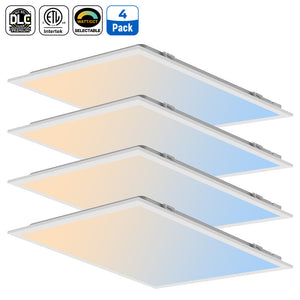
Best practice guidelines for mixing
- Keep each fixture type to separate zones rather than alternating them next to each other within the same functional area.
- Match correlated colour temperature (CCT), CRI and target lux level for all fixtures.
- Select low‑UGR troffer models if troffers must be near workstations.
- Check physical flush‑mount depth to minimise visual mismatch on ceiling grids.
Short conclusion
Mixed installation is technically feasible. It works best for zoned spaces, not random side‑by‑side placement within the same primary working area.
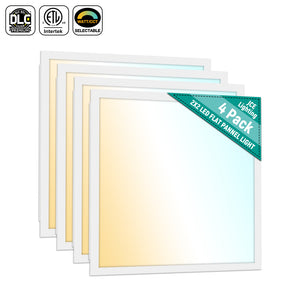
Key Differences between LED panel lights and troffer lights
Though both fit standard suspended ceiling grids (2×2 ft, 2×4 ft) for commercial indoor lighting, they differ greatly in structure, optical performance, installation and scenarios.
1. Housing & physical design
- LED panel light: Ultra‑slim, thin flat profile. Two main types: edge‑lit (LEDs along frame edges with light‑guide plate) and back‑lit (LED array behind diffuser). Minimalist flush appearance with shallow depth.
- LED troffer light: Deeper tray‑style metal housing, inherited from old fluorescent troffer fixtures. Inside are reflectors, louvers or optical lenses, greater overall depth.
2. Light distribution & glare performance
- LED panel light: Produces soft, highly uniform diffused ambient light across the whole surface. Low UGR (Unified Glare Rating), less visual discomfort, well‑suited for screen‑heavy offices.
- LED troffer light: Light is controlled by reflectors/louvers. More directional output. Delivers strong task‑oriented illumination; some models have moderate glare without advanced optics.
3. Installation flexibility
- LED panel light: Multi‑mode installation: recessed into grid ceilings, surface‑mounted onto solid ceilings, or suspended by wires. Works for both grid and non‑grid ceilings.
- LED troffer light: Primarily recessed lay‑in for T‑bar drop ceiling grids. Designed as direct replacement for legacy fluorescent troffers; surface‑mount or suspension are not native options.
4. Retrofit compatibility
- LED panel light: For new construction is ideal. Retrofitting old fluorescent troffer openings may require minor ceiling adjustments.
- LED troffer light: Purpose‑built retrofit solution. Fits existing troffer cut‑outs perfectly, fast swap‑out without modifying ceiling structures.
5. Cost
- LED panel light: Generally lower upfront material cost.
- LED troffer light: Higher initial cost due to deeper housing and built‑in optical accessories (louver, reflector).
6. Typical application scenarios
- LED panel light: Modern offices, retail shops, classrooms, conference rooms; spaces prioritizing visual comfort and clean ceiling aesthetics.
- LED troffer light: Retrofit projects, hospitals, labs, warehouses, back‑of‑house zones; task‑focused commercial environments needing quick fixture replacement.
Quick comparison table
| Item | LED panel light | LED troffer light |
|---|---|---|
| Housing | Ultra‑thin flat | Deep tray‑shaped |
| Light | Soft uniform ambient light | Directional controlled task light |
| Installation | Recessed / surface / suspended | Mainly recessed grid ceiling |
| Retrofit | Better for new build | Excellent for old‑fixture replacement |
| Glare | Low‑UGR, eye‑friendly | Depends on louvers/lenses |
| Best for | Modern offices & retail | Retrofit, task‑oriented commercial spaces |
Note: Energy efficiency and service life (≈50 000 hours) are comparable for high‑quality versions of both types, determined more by LED chips and drivers than fixture category.
How to choose the appropriate light source for specific indoor lighting
Selecting a suitable light source or luminaire requires evaluating space function, visual needs, environment conditions, aesthetic requirements and economic factors. Below are the core considerations:
1. Identify the function and usage of the space
Different activities demand different lighting levels.
- Work‑oriented areas (offices, classrooms): Require sufficient, low‑glare illumination for reading and screen work. Prioritise low UGR, high CRI products such as LED panel lights.
- Rest or circulation areas (corridors, lounges): Lower illuminance is acceptable; focus on comfort and orientation.
- Task‑intensive areas (laboratories, workshops): Need high brightness and good colour rendering; troffer lights or high‑output task lighting may apply.
- Retail / display zones: High CRI to show true colours of goods.
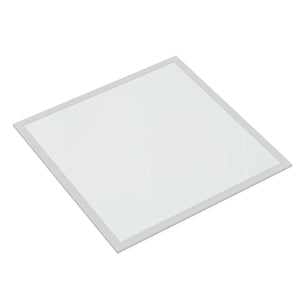
2. Key lighting performance parameters
- Illuminance (lux): Match recommended lux value according to space activity. Too dark causes eye strain; overly bright wastes energy.
-
Correlated Colour Temperature (CCT)
- Warm white (2700‑3000K): bedrooms, restaurants, lounge areas, creates cosy atmosphere.
- Neutral white (4000K): offices, meeting rooms, retail; balanced natural feeling.
- Cool white (5000‑6500K): classrooms, warehouses, hospitals; alert, bright effect.
- Colour Rendering Index (CRI / Ra): Higher Ra means more realistic colour. Working and display spaces require Ra ≥ 80.
- Glare rating (UGR): Spaces with computers or long‑time visual work need low‑UGR fixtures to avoid visual discomfort.
- Luminous efficacy (lm/W): Measure energy efficiency; higher value saves electricity.
3. Ceiling structure and installation conditions
- T‑bar drop ceiling: Both LED panel lights and troffer lights can be used.
- Solid/plaster ceiling: LED panel lights support surface‑mount or suspension; troffers are mostly recessed lay‑in only.
- Retrofit project: If replacing old fluorescent troffers, LED troffer lights fit existing openings with little modification. For new construction, slim LED panels offer better aesthetics.
4. Environmental factors
- Damp areas (bathrooms, kitchens): Choose lights with appropriate IP rating for moisture resistance.
- Dust‑prone industrial or storage rooms: Select sealed, dust‑resistant fixtures.
- Special requirements: Compatibility with dimmers, motion sensors or smart lighting control systems.
5. Aesthetic requirements
- Modern, clean ceiling appearance: Prefer ultra‑slim LED panel lights.
- Less visible appearance change for old ceiling grids: Troffer lights are more suitable.
- Keep fixture style consistent within one functional zone; avoid random mixing of different optics side‑by‑side.
6. Economic factors
- Initial purchase cost: Compare budget for fixtures, drivers and accessories.
- Operating cost: Energy consumption, lamp lifespan, maintenance and replacement frequency. High‑quality LED has long service life and reduces long‑term running expense.
Simple decision‑making summary workflow
- Clarify space function → set target illuminance.
- Select suitable CCT, CRI and UGR.
- Check ceiling type and installation way (new build or retrofit).
- Consider environment protection grade and control requirement.
- Balance aesthetic effect with total cost (capital + running + maintenance).
Example: For a new‑build open‑plan office with computer workstations Requirement: low glare, neat ceiling; ceiling is T‑bar grid. Choice: LED panel lights (neutral white 4000K, low‑UGR, Ra≥80).
How to ensure the energy efficiency of indoor lighting sources
- Select high‑efficiency light sources and luminaires Choose LED products with high luminous efficacy (lm/W). Avoid outdated light sources such as incandescent lamps and traditional fluorescent lamps. Compare luminaire efficiency: well‑designed LED panel lights and troffer lights reduce light waste through good diffusers or reflectors. High‑quality drivers also improve overall system efficiency, not just LED chips.
- Adopt reasonable lighting design, avoid over‑lighting Calculate required illuminance (lux) according to space usage. Do not simply install more high‑power fixtures. Apply local task lighting combined with general ambient lighting, instead of relying entirely on high‑power overhead lights. Avoid light overflow and wasted brightness for areas that do not need high illumination.
- Install intelligent lighting control systems
- Occupancy / motion sensors: turn lights off or dim when rooms are unoccupied.
- Daylight harvesting sensors: dim artificial light when natural daylight is sufficient.
- Dimmers and time‑scheduling controls: adjust brightness according to working hours and actual needs. These measures prevent lights from running at full power unnecessarily.
- Make good use of natural daylight Maximise natural light through windows and glass partitions. Arrange work zones close to daylight sources. Reduce artificial lighting usage during daytime hours.
- Correct fixture selection and installation Select appropriate beam angles and optical accessories (diffusers, reflectors) to direct light onto target working surfaces. Avoid mis‑aimed light wasted on walls or ceilings. Ensure installation position and spacing follow lighting design standards to prevent uneven lighting and excessive fixture quantity.
- Regular maintenance
- Clean lamp surfaces, diffusers and reflectors periodically. Dust accumulation reduces light output significantly.
- Replace ageing drivers and degraded LED fixtures in time. Old LED units produce less light while still consuming power.
- Keep reflectors and lenses in good condition.
- Reasonable layout and zoning control Divide large indoor spaces into independent lighting zones. Turn on lights only for occupied zones rather than the whole building. Separate control for corridors, meeting rooms and working areas.
- Consider whole‑life‑cycle cost Do not only pursue the lowest purchase price. Low‑cost poor‑quality LEDs and drivers have low real‑world efficiency and short service life. Choose certified energy‑saving products to lower long‑term electricity and replacement costs.
Short summary (for exam answer)
To ensure indoor lighting energy efficiency: choose high‑efficiency LED light sources, implement proper lighting design to prevent over‑illumination, utilise natural daylight, apply smart controls such as sensors and dimmers, install fixtures correctly for effective light distribution, carry out regular cleaning and maintenance, and adopt zoned lighting management.


