

Common Mistakes When Choosing Outdoor Flood Lights
1. Judging brightness by watts instead of lumens
Most shoppers still pick flood lights based on wattage, not lumens. Watts only measure power consumption, not actual brightness.
- Mistake: Buying a high-watt halogen light thinking it’s brighter; it wastes electricity and produces harsh heat.
- Fix: Always reference lumens. Small yards need 700–1500 lm; large security areas need 3000 lm+.
2. Picking the wrong color temperature for the space
- Too cool (5000K–6500K daylight) for patios, decks, or seating areas: Stark white light creates an uncomfortable, hospital-like harsh atmosphere that ruins relaxing outdoor spaces.
- Too warm (2700K–3000K yellow) for security lighting: Warm yellow light blurs facial details and makes it hard for security cameras to capture clear footage.
- Many homeowners also mix mismatched color temperatures across the yard, creating disjointed, uneven lighting.
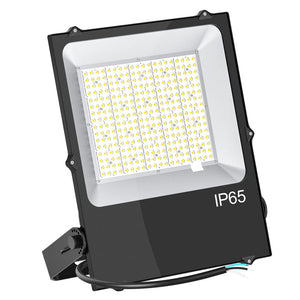
3. Ignoring waterproof IP ratings
A top frequent error is buying cheap lights with IP44 or lower for exposed outdoor areas.
- Low IP ratings cannot withstand heavy rain, snow, or dust, leading to water seepage, short circuits, and early burnout.
- Coastal homeowners skip anti-corrosion aluminum housings; salt spray quickly rusts cheap plastic/metal casings.
- Rule: All permanent outdoor flood lights need IP65 minimum; rainy coastal regions require IP66/IP67.

4. Misjudging beam angle
- Too narrow beam (15°–30°) for wide lawns: Creates isolated bright spots with huge dark shadow zones—perfect hiding spots for trespassers.
- Too wide beam (120°+) for long driveways or tall perimeter walls: Light spreads too thin, failing to illuminate far distances.
- Many buy one single ultra-wide floodlight to cover a big yard instead of multiple targeted fixtures, leaving dark corners.
5. Poor planning for light pollution & neighbor glare
- Unshielded bare floodlights cast bright light straight into neighboring windows, patios, or bedrooms, causing disputes.
- Overpowered high-lumen security lights create blinding glare; strong glare produces deep black shadows where intruders can hide (counterproductive for safety). Most people fail to choose shielded fixtures or adjust mounting angles downward to contain light within their own property.
6. Choosing the wrong sensor type or misadjusting sensors
- Buying dusk-to-dawn lights for security: They stay lit all night, wasting power and losing the surprise factor that scares off thieves. Motion sensors are far better for security.
- Overly sensitive PIR motion sensors: Constantly trigger from small animals, wind-blown trees, or passing cars, annoying homeowners and draining power.
- Insufficient sensor detection range/angle: The light fails to activate when people walk up driveways or side yards.
- No adjustable timer settings: Lights stay on for 10+ minutes unnecessarily after motion stops.
7. Picking flood lights for primary security lighting
lights are popular for their zero-wire convenience, yet many rely on them as the main yard security light.
- Weak battery storage means dim output on cloudy days, short runtime at night.
- Batteries degrade rapidly after 2–3 years, drastically cutting brightness. Solar floodlights only work as secondary accent lighting; LED hardwired lights are required for reliable security.
8. Cheap plastic housings instead of aluminum
Budget plastic floodlight casings crack, fade, and turn brittle after prolonged UV sun exposure. They also dissipate heat poorly, shortening LED lifespan. Aluminum alloy housings offer heat dissipation, rust resistance, and 5–10 year durability but are often overlooked to save upfront cost.
9. Neglecting mounting flexibility
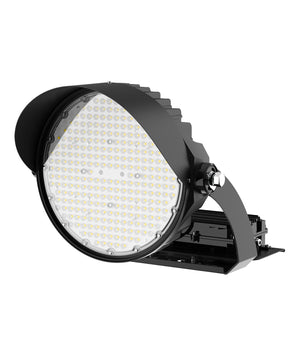
Buying fixed, non-adjustable flood light brackets is a common oversight.
- Fixed lights cannot be tilted to target driveways, entry doors, or perimeter fences.
- Users end up with wasted light shining uselessly at rooftops or empty sky instead of ground surfaces. Always select fixtures with fully vertical/horizontal adjustable brackets.
10. Overlooking CRI (Color Rendering Index) for security
Shoppers rarely check CRI ratings. Low CRI (<70) lights distort colors, making it impossible to accurately identify clothing, vehicles, or people’s faces on security camera footage. For safety, CRI 80+ is essential, yet many low-cost flood lights cut corners on color rendering.
11. Overloading or underpowering the space
- Underpowering: Small 1000-lumen lights for large backyards or commercial lots leave most areas dim and unsafe.
- Overpowering: Installing 8000–10000-lumen industrial flood lights for small residential patios creates overwhelming, uncomfortable brightness and massive energy waste.
12. Forgetting seasonal weather conditions
Homeowners in snowy, flood-prone, or coastal areas buy standard indoor-grade lights without considering:
- Snow buildup blocking light output
- Flooding submerging low-mounted fixtures
- Salt air corrosion near the ocean These environmental factors drastically shorten fixture lifespan if unaccounted for.
How to Choose Flood Lights for Your Outdoor Space
Flood lights provide wide, bright illumination for yards, driveways, patios, gardens and building exteriors. Follow this complete guide to pick the right ones for your needs.
1. Select the Right Light Source (LED is the Top Pick)
Main Types
- LED Flood Lights (Recommended) Pros: Ultra energy-efficient, long lifespan (30,000–50,000 hours), low heat, instant full brightness, dimmable options. Low monthly electricity cost. Cons: Slightly higher upfront price than halogen.
- Halogen Flood Lights Pros: Cheap initial cost, warm natural light. Cons: High power consumption, short service life, run extremely hot, fire risk near plants/wood. Not eco-friendly.
- Solar Flood Lights Pros: Zero electricity bills, easy wire-free installation, ideal for remote yards without power outlets. Cons: Dim on cloudy days, weaker brightness, battery degradation over 2–3 years. Best for secondary lighting, not main security lights.
2. Determine Brightness: Lumens (Not Watts)
Watts only measure power use; lumens measure actual brightness. Match lumens to your space size:
- Small side yard / small patio: 700–1,500 lumens
- Standard driveway / front yard: 1,500–3,000 lumens
- Large backyard / commercial lot / security perimeter: 3,000–10,000 lumens
- Extra-wide coverage (warehouse, big garden): 10,000+ lumens
Tip: For security lighting, avoid overly blinding lights that create harsh shadows (thieves hide in dark blind spots). Moderate, even brightness works best.
3. Pick the Correct Color Temperature (Kelvin, K)
Color temperature changes the light’s tone and outdoor usability:
- 2700K–3000K Warm White Soft yellow glow. Perfect for patios, seating areas, landscape decor—creates cozy, relaxing atmosphere. Poor for security detail recognition.
- 4000K Neutral White Balanced natural white. Most versatile choice: driveways, garages, general yard lighting, home security. Clearly shows colors and faces without harshness.
- 5000K–6500K Cool Daylight Bright stark white. Ideal for heavy security, construction areas, parking lots. Sharp visibility for cameras, but looks harsh for leisure spaces.
4. Check Waterproof & Weather Rating (IP Rating)
Outdoor flood lights must resist rain, snow, dust and humidity. Focus on the IP65 / IP66 / IP67 rating:
- IP65: Fully dustproof, resistant to splashing rain (standard residential outdoor use)
- IP66: Heavy rain jet-proof, suitable for coastal areas with salt spray
- IP67: Submersible briefly; great for low ground areas prone to flooding Avoid lights below IP65—they will short out in rain. For coastal homes, choose anti-corrosion aluminum housings to fight salt rust.
5. Choose Smart Control Functions
Match controls to your purpose (security vs. decoration):
- Motion Sensor (PIR) Auto turns on when people/animals pass. Saves energy, deters intruders. Adjustable sensitivity and lighting duration (10s–10min). Must have a detection angle matching your space.
- Dusk-to-Dawn Photocell Sensor Automatically activates at sunset and shuts off at sunrise. Ideal for constant all-night yard lighting without manual switching.
- Smart App / Bluetooth / Wi-Fi Flood Lights Remote dimming, scheduled timers, color changing (RGB models). Good for decorative patios; adjust brightness from your phone.
- Manual Switch Only Budget basic lights for small spaces you turn on/off yourself.
6. Beam Angle for Coverage Range
Beam angle decides how wide the light spreads:
- 15°–30° Narrow Beam: Long-distance focused light (driveway end, tall wall, tree uplighting)
- 45°–90° Medium Beam: Balanced spread for most front yards and garages
- 100°–150° Wide Beam: Large open backyards, lawns, parking areas (wide blanket lighting)
If you have an irregular-shaped yard, buy multiple narrow-angle lights instead of one ultra-wide light to eliminate dark corners.
7. Housing Material & Mounting Options
Housing
- Aluminum alloy: Durable, heat dissipation, rust-resistant (best long-term choice)
- Plastic: Cheap, lightweight, but fades and cracks after 2–3 years of sun exposure
Mount Types
- Wall-mounted: Standard for house exteriors, garages
- Ground stake: Solar flood lights for gardens, flower beds
- Pole-mounted: Driveways, large lawns, parking areas
- Adjustable bracket: Tilt up/down/side to target specific zones (critical for security)
8. Extra Tips for Special Scenarios
- Security Lighting Combo: 4000K neutral LED + PIR motion sensor + IP66 waterproof, 2000–4000 lumens. Avoid glare toward neighbors’ windows.
- Relaxed Patio Lighting: 2700K warm LED, lower lumens, dimmable, wide beam for soft ambiance.
- No Power Access: Solar flood lights with large solar panels and lithium batteries. Add a small solar battery pack for longer runtime.
- Neighbor-Friendly Rule: Select shielded flood light fixtures to stop light pollution spilling onto adjacent properties.
- Energy Saving: Prioritize LED with high CRI (CRI>80) – renders true colors, better for identifying people/objects.
Quick Buying Checklist Before Purchase
- Light type: LED (main) / Solar (wireless)
- Lumens matched to space size
- Color temperature fitting usage scene
- IP rating ≥IP65
- Control type: motion / dusk-dawn / smart
- Suitable beam angle & adjustable mount
- Rust-proof aluminum housing (for long service life)
- Shielded design to reduce light pollution
How to calculate the appropriate lumens needed for a specific outdoor space?
Lumens measure total visible light output. Outdoor lumen requirements depend on 3 key factors:
- Square footage of the area
- Purpose of lighting (security / casual ambiance / work area)
- Desired light level (measured in foot-candles, fc)
Key Formula
Total Required Lumens = Square Footage × Target Foot-Candles ÷ Light Efficiency Loss Factor
- Loss Factor: 0.7–0.85 for outdoor LED flood lights (accounts for dust, weather, light spill, fixture shading; use 0.75 as standard average)
Step 1: Measure your outdoor area (square feet)
- Rectangular space: Length (ft) × Width (ft) = sq. ft Example: 20ft driveway × 10ft wide = 200 sq. ft
- Irregular yards: Split into multiple rectangles, calculate each and add together.
- Perimeter security (fence lines): Calculate total ground area you want illuminated, not just wall length.
Step 2: Standard Foot-Candle (fc) Targets for Outdoor Use
Foot-candles = how bright the ground surface needs to be (industry residential standards):
| Outdoor Space Type | Target Foot-Candles (fc) | Purpose Description |
|---|---|---|
| Patio, garden, decorative walkway | 2–5 fc | Relaxation, soft ambiance |
| Front entry door, small side yard | 5–10 fc | General daily visibility |
| Residential driveway, backyard general security | 10–20 fc | Standard home safety, camera clarity |
| High-security perimeter, parking lot, workshop | 20–50 fc | Clear facial identification, nighttime work |
| Commercial / warehouse lots | 50–100 fc | Heavy-duty industrial lighting |
Step 3: Complete Lumen Calculation Example
Example 1: Standard 200 sq. ft residential driveway (security, target 15 fc)
- Area = 200 sq. ft
- Target fc = 15
- Loss factor = 0.75 Total Lumens = (200 × 15) ÷ 0.75 = 3000 ÷ 0.75 = 4,000 total lumens needed
You can split this: one 4000lm floodlight, or two 2000lm lights for even coverage.
Example 2: Small 80 sq. ft patio (relaxed ambiance, target 3 fc)
Total Lumens = (80 × 3) ÷ 0.75 = 240 ÷ 0.75 = 320 total lumens
Example 3: Large 600 sq. ft backyard high-security zone (25 fc)
Total Lumens = (600 × 25) ÷ 0.75 = 15000 ÷ 0.75 = 20,000 total lumens
Step 4: Adjust for Extra Variables (Critical Modifiers)
Multiply your calculated total lumens by these adjustment factors if applicable:
- Dark surroundings / wooded yards: ×1.2 (more light needed to offset heavy shadow)
- Light-colored pavement (white concrete): ×0.8 (surfaces reflect light, less lumens required)
- Dark pavement / dirt lawn / dark brick: ×1.2–1.3 (absorbs light, boost brightness)
- Coastal / rainy regions (more fixture dirt buildup): ×1.1 (higher light loss over time)
- Wide beam angles over 100°: ×1.1 (light spreads thin, add extra lumens)
Adjustment Example: The 200 sq ft driveway (4000lm total) with dark asphalt ground: 4000 × 1.2 = 4,800 total lumens required
Step 5: Distribute Lumens Across Multiple Fixtures
Never rely on one ultra-bright light for large spaces—causes glare and dark shadows.
- Split total lumens evenly across multiple flood lights
- Match beam angles: Wide beams for open lawns, medium beams for driveways, narrow beams for long-distance perimeter walls
Example: Need 4,800 total lumens Option: Two 2400lm LED flood lights mounted on opposite sides of the driveway for even illumination.
Quick Reference Lumen Cheat Sheet (No Math Needed)
For fast shopping without calculating square footage:
| Space Size & Use | Recommended Total Lumens |
|---|---|
| Tiny patio / flower beds | 700–1,500 lm |
| Small front yard / entry door | 1,500–3,000 lm |
| Standard single-car driveway | 3,000–5,000 lm |
| Large two-car driveway / medium backyard | 5,000–8,000 lm |
| Big backyard / full perimeter security | 8,000–15,000 lm |
| Large parking / workshop area | 15,000–30,000 lm |
Common Calculation Mistakes to Avoid
- Ignoring the loss factor: Buying lights with only the raw calculated lumens leads to dim real-world lighting.
- Overlooking surface color: Dark grass/asphalt needs far more lumens than light concrete.
- Using one powerful high-lumen light instead of multiple smaller lights (creates blinding glare and shadow blind spots).
- Confusing wattage with lumens: A 50W LED = ~5,000 lumens; a 50W halogen only = ~800 lumens—wattage cannot replace lumen math.
- Under-sizing lumens for security cameras: Low lumens + low CRI produce blurry, unusable night footage. Stick to minimum 10fc for camera zones.


