

Choosing the right LED troffer lights involves looking at your existing setup, understanding a few key performance metrics, and deciding between a full replacement or a retrofit. Since you're likely upgrading from fluorescent, the goal is to match or improve light levels while maximizing energy savings.
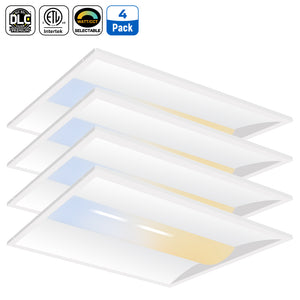
Key Factors to Consider
-
Size and Grid Compatibility: Troffer lights are designed to fit standard drop-ceiling grids. The most common sizes are 2x4 feet, 2x2 feet, and 1x4 feet. Measure your grid opening before purchasing to ensure a proper fit.
-
Color Temperature (CCT): The color of the light affects the mood and productivity of the space:
-
3500K (Neutral White): Offers a balanced, slightly warm light ideal for general offices.
-
4000K - 4100K (Cool White): Provides a crisp, clean light great for classrooms, conference rooms, and workspaces.
-
5000K (Daylight): Delivers a very bright, bluish-white light suitable for hospitals, retail spaces, or detailed work areas.
-
-
Lumens and Brightness: Do not rely solely on wattage. Look at lumens (the amount of light emitted). A standard 2x4 troffer typically ranges from 3,500 to 5,000 lumens depending on your ceiling height and lighting requirements.
-
Wattage Selectability: Many modern LED troffers come with selectable wattage switches on the fixture, allowing you to adjust the brightness level after installation.
-
Dimming Capabilities: Look for fixtures with 0-10V dimming drivers if you want the flexibility to connect them to wall dimmers or daylight harvesting sensors.
-
Lens Type: Troffers usually feature either a prismatic lens (diffuses light evenly to reduce glare) or a volumetric/basket design (provides soft, ambient, indirect lighting that is much easier on the eyes during long workdays).
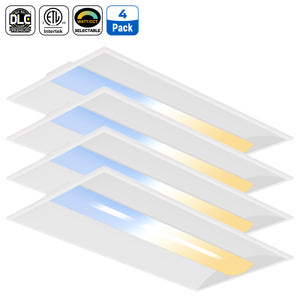
Here is a guide to help you select the right fixtures.
Step 1: Decide on Your Upgrade Path
First, determine how you want to upgrade. The best choice depends on the condition of your current fixtures and your budget .
-
Full Fixture Replacement (Recommended): Best if your existing housings are old, discolored, or if you want the highest energy savings, modern controls (like dimming), and the best warranty. This is the cleanest option .
-
Retrofit Kit: Keeps the existing metal housing but replaces the internal components (LED module, driver, lens). Good for tight budgets or when the housing is in good condition . Note that rebates might be lower for this option .
-
LED Tubes (Type B): The cheapest upfront option. You bypass the ballast and put LED tubes in your old fixture. However, light quality and distribution can be inconsistent, and it's generally not recommended for main office spaces .
- Step 2: Match the Right Technical Specs
If you are buying new fixtures, you need to match the light output, not just the wattage. LED troffers are far more efficient than fluorescent, so a 30W LED can often replace a 50W fluorescent fixture .
-
Lumens (Brightness): Don't guess based on your old bulbs. Check your current fluorescent lamp's initial lumens and aim for a similar total luminaire lumen output. You can also use photometric software (like AGi32 or DIALux) to simulate the room, or simply measure your current light levels with a meter and match them . Typical replacements:
-
1x4 or 2x2 (for 2 or 3 lamp fixtures): Look for 2,500 – 4,000 lumens.
-
2x4 (for 3 or 4 lamp fixtures): Look for 4,000 – 6,500 lumens.
-
-
Efficacy (Efficiency): This is the most important metric. Look for a luminaire efficacy of 100 lumens per watt (lm/W) or higher. Some modern LED troffers reach 120-130 lm/W .
-
Color Temperature (CCT): For offices and schools, 3500K or 4000K is standard and provides a neutral, productive feel. 5000K is sometimes used for retail or clinical settings .
-
CRI (Color Rendering Index): Look for CRI ≥ 80. This ensures colors look natural under the light .
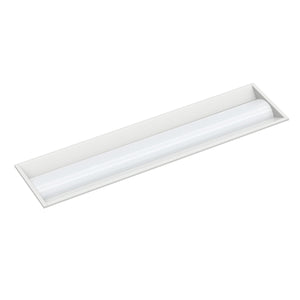
Step 3: Consider the Optics and Controls
-
Distribution and Glare: Look for a wide-distribution (diffuse) lens rather than a clear one. Wide distributions provide a softer, more uniform light that is less likely to cause glare or a "striped" look, especially in spaces with computer screens .
-
Dimming and Controls: If you want to save more energy, look for fixtures compatible with 0-10V dimming. This allows you to pair them with occupancy sensors or daylight harvesting systems . Be aware that some cheaper LED drivers can produce flicker when dimmed low, so testing a sample is wise .
Step 4: Choose the Right Supplier
If you are buying in bulk, verify the supplier's credibility.
-
Certifications: Ensure the products are UL Listed for safety and DLC Listed if you want to qualify for utility rebates .
-
Test Reports: Ask for LM-79 (photometric) and LM-80 (lifespan) reports to verify performance claims .
-
Warranty: A minimum of 5 years is standard for a quality commercial fixture .
A final piece of advice: Before placing a large order, buy a sample fixture. Install it in the actual space and compare it side-by-side with the existing lighting. Evaluate the brightness, color, and glare in person. What looks good on a spec sheet might not feel right in your room.
Making the selection among LED Troffer lights becomes simple when making decisions in the right order. Select the size first followed by lumens, color temperature, dimming capability, light quality, voltage, and future requirements.
Selecting based on wattage or pricing is not the best way to make this decision. It is important to select the fixture that suits the room and allows for useful features without having useless additional features.
If working on commercial lighting projects, it is good to go with JCELighting which has troffer lights suited for various drop ceiling designs.
Call +1 718-688-9188 to speak with a US-based lighting professional expert or browse Commercial LED Troffer Lights Solutions at www.jcelighting.com


