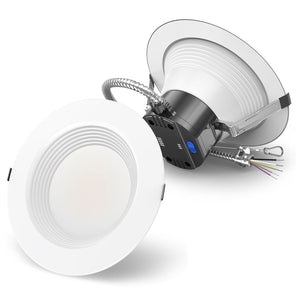
LED Downlight Spacing Guide
Proper spacing is one of the most important factors when designing a recessed lighting layout.
Well-positioned LED downlights create uniform illumination, reduce shadows, and improve overall visual comfort.
As a general guideline, the spacing between downlights should be approximately half of the ceiling height.
For example, in a room with an 8-foot ceiling, fixtures are commonly spaced about 4 feet apart.
Higher ceilings may require wider spacing or higher lumen output fixtures to maintain consistent light distribution.
| Ceiling Height |
Recommended Spacing |
| 8 ft |
4 - 5 ft |
| 10 ft |
5 - 6 ft |
| 12 ft |
6 - 8 ft |
| 15 ft+ |
8 - 10 ft |
For task-oriented spaces such as kitchens, conference rooms, reception areas, and retail environments,
closer fixture spacing may be required to achieve higher illumination levels and improved visual performance.
How to Choose the Right Color Temperature
Color temperature directly affects the atmosphere and functionality of a space.
Modern LED downlights are available in multiple color temperatures, allowing users to create the ideal lighting environment for different applications. :contentReference[oaicite:1]{index=1}
| Color Temperature |
Appearance |
Recommended Applications |
| 3000K |
Warm White |
Hotels, Restaurants, Residential Spaces |
| 4000K |
Neutral White |
Offices, Schools, Commercial Interiors |
| 5000K |
Daylight White |
Warehouses, Retail Stores, Healthcare Facilities |
For most commercial projects, 4000K is often considered the preferred balance between comfort and visibility.
For environments where maximum clarity and brightness are required, 5000K daylight white is commonly selected.
Common Applications of LED Downlights
Commercial Office Lighting
LED downlights provide clean, professional illumination for open offices, meeting rooms, corridors, and reception areas.
Their recessed design creates a modern appearance while supporting employee productivity and visual comfort.
Retail Stores & Showrooms
Retail environments benefit from uniform lighting that enhances product visibility and customer experience.
LED downlights can be used for both ambient lighting and accent lighting throughout stores and commercial display areas.
Hotels & Hospitality Projects
Hotels, resorts, restaurants, and hospitality venues frequently use recessed downlights to create a premium atmosphere while maintaining energy efficiency and low maintenance requirements.
Healthcare Facilities
Hospitals, clinics, and medical offices require reliable, consistent lighting performance.
LED downlights help improve visibility while reducing maintenance disruptions in occupied spaces.
Residential Applications
Modern homes often incorporate LED downlights in kitchens, living rooms, bedrooms, hallways, and bathrooms to achieve a clean architectural look and long-lasting performance.
LED Downlights vs Traditional Lighting
| Feature |
LED Downlights |
CFL Fixtures |
Halogen Fixtures |
| Energy Efficiency |
Excellent |
Moderate |
Low |
| Typical Lifespan |
Up to 50,000 Hours |
8,000-15,000 Hours |
2,000-5,000 Hours |
| Maintenance Cost |
Low |
Medium |
High |
| Instant On |
Yes |
Limited |
Yes |
| Heat Generation |
Low |
Medium |
High |
| Long-Term Cost Savings |
Excellent |
Moderate |
Low |
Compared with traditional lighting technologies, LED downlights offer significantly lower energy consumption,
longer service life, reduced maintenance costs, and improved lighting quality, making them the preferred choice for modern commercial and residential lighting projects.